Black Women of the Harlem Renaissance Era by Lean'tin L. Bracks & Jessie Carney Smith
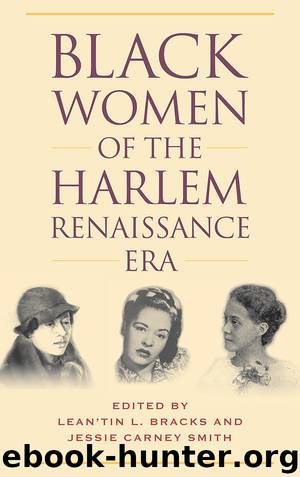
Author:Lean'tin L. Bracks & Jessie Carney Smith [Bracks, Lean’tin L. & Smith, Jessie Carney]
Language: eng
Format: epub
Publisher: Rowman & Littlefield Publishers
Published: 2014-04-07T04:00:00+00:00
Lois Mailou Jones
Lois Mailou Jones was a formally trained artist who used her skills as a designer and impressionistic painter to create stories that reflect black experiences and her own life in Boston, the American South, the Caribbean, and Africa. Her involvement in the New Negro Movement enabled her to enrich its visual arts focus and pass on the Harlem Renaissance legacy to future generations through her many exhibitions and forty-seven-year teaching career at Howard University.
Jones was born in Boston, Massachusetts, on November 5, 1905, to Thomas Vreeland Jones, a lawyer and real estate entrepreneur, and Carolyn Dorinda Adams, a cosmetologist. She began her art training at the High School of Practical Arts and later won a four-year scholarship to the School of the Museum of Fine Arts in Boston. In 1953, she married Haitian artist Louis Vergniaud Pierre-Noel.
In spite of Jones’s extensive training and strong portfolio, she was initially compelled to submit her work to businesses through a white artist. During the late 1920s, she worked as a freelance textile designer for the F. A. Foster Company in Boston, as well as the Schumacher Company in New York. Business policy, however, dictated that the design houses receive acknowledgment for the work created, not individual artists. In addition to her textile work, Jones illustrated black history stories for Associated Publishers of Washington, D.C., founded by historian Carter G. Woodson. Jones’s designs for paper mâché masks were inspired by traditional examples from throughout the world. She also designed masks for African dancer Asadata Defora’s dance company.
Through an association with the Harmon Foundation and interactions with other black artists of the 1920s and 1930s, Jones explored the richness of the black experience early in her career. She was a participating artist in the foundation’s exhibitions held in 1930, 1931, and 1933, and she won honorable mention in 1931 for Negro Youth, a charcoal drawing. Inspired by the stylistic leadership of fellow artists like Aaron Douglas, Jones’s The Ascent of Ethiopia, painted in 1932, depicts the story of black history from ancient Africa to the arts-focused 1930s.
Jones’s art career was bolstered by exhibitions at La Boheme Tea Room in New York (1927); the Salon of the Société des artistes français and Société des artistes indépendants in Paris (1938); the Robert C. Vose Galleries in Boston (1939); the Pennsylvania Academy of the Fine Arts (1935 and 1938); the Howard University Gallery of Art (1937); and Morgan State College (now Morgan State University, 1940). In 1941, the painting Indian Shops, Gay Head, Massachusetts won her the Robert Woods Bliss Prize for Landscape at the Corcoran Gallery of Art in Washington, D.C. A major retrospective of her work was held in 1990, at the Meridian International Center of Washington, D.C.
In 1930, Jones began her teaching career at Howard University, following her establishment of the art department at Palmer Memorial Institute in Sedalia, North Carolina. At Howard, she dedicated her time to teaching design, drawing, and watercolor painting. During her tenure, her students included artists Elizabeth Catlett, David C.
Download
This site does not store any files on its server. We only index and link to content provided by other sites. Please contact the content providers to delete copyright contents if any and email us, we'll remove relevant links or contents immediately.
Kitchen confidential by Anthony Bourdain(3091)
I Know Why the Caged Bird Sings by Maya Angelou(2146)
Dry by Augusten Burroughs(2102)
Kitchen Confidential by Anthony Bourdain(1913)
A Child Called It by Dave Pelzer(1877)
I know why the caged bird sings by Maya Angelou(1864)
KITCHEN CONFIDENTIAL Adventures in the Culinary Underbelly by Anthony Bourdain(1801)
A Heartbreaking Work of Staggering Genius by Dave Eggers(1793)
all by Unknown Author(1682)
Zeitoun by Dave Eggers(1655)
Vogue on Yves Saint Laurent by Natasha Fraser-Cavassoni(1610)
Taken by J. C. Owens(1561)
Extraordinary, Ordinary People by Condoleezza Rice(1503)
A Stolen Life by Dugard Jaycee(1500)
The Farm in the Green Mountains by Alice Herdan-Zuckmayer(1456)
Law Man by Shon Hopwood(1443)
House of Darkness House of Light by Andrea Perron(1410)
The Year of Yes by Maria Headley(1370)
The Big Sea by Langston Hughes(1349)
